
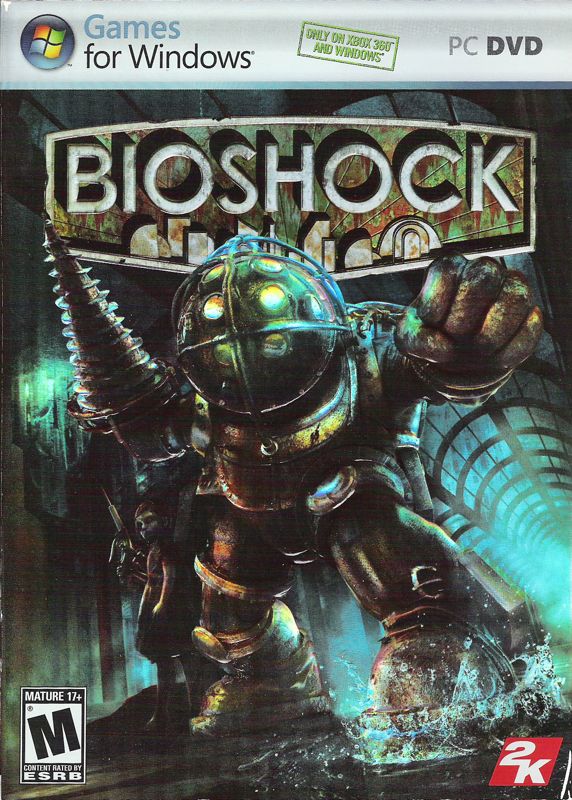
Your plane goes down before you ever learn your own name, and the first thing your hands find is a lighthouse standing alone in the black Atlantic, one door, no explanation offered. You go through it. A bathysphere hauls you down into the dark, a scratchy film reel plays a dead man’s sales pitch, and then a drowned city blooms on the other side of the glass. I have started BioShock more times than I can count and that descent still gets me every single time. This is a game that treats its setting as an argument instead of a backdrop, and it wins that argument on craft alone.
A utopia that curdled
Rapture is a city on the ocean floor, built by a man who decided the world’s great men should be free of God, government and everyone else’s morals. Pure will, no chains, no parasites. By the time you show up it has devoured itself, and the whole place stands as a monument to what happens when a gorgeous idea meets actual human beings and loses in a landslide.
What makes it land is that the game never once climbs onto a soapbox. It hands you a leaking, beautiful ruin and trusts you to read it. You pass a frozen ballroom, a shop that sold gene therapy like it was toothpaste, a body nobody came back for, and the philosophy assembles itself in your skull without a single character pausing to explain the theme to you like you are five. That restraint is rarer than it sounds. Most games would sell a kidney for that much faith in their own audience.
Storytelling through walls and static
The audio diaries are the trick everyone copied afterward and almost nobody matched. You pull a little recorder off a corpse, hit play, and a voice from before the fall gives you one small human thing: a doctor talking himself into the first unforgivable choice, a mother watching her neighbors turn, an artist cashing out his soul. Stitch enough of them together and you have lived through the death of a civilization with nobody narrating it at you. The city tells its own story through what got left behind, and you are the one doing the reading.
The art deco is the other half. Rapture is one of the best looking worlds ever built for a game, and the age barely shows, because the style was never chasing realism in the first place. Water sheets down the glass, neon hums over a body nobody moved, the whole thing feels wet and grand and rotten. It is the closest a game has come to the feeling I get standing inside the best production design in cinema.
Where the seams show
I will grant the honest gap, because it is the reason this is a five star game and not an untouchable one. The moment to moment shooting is the least interesting thing here. The guns feel fine, the plasmids (lightning out of your left hand, fire, a swarm of furious bees) are a genuine kick for a while, and the enemies you trade fire with for hours are more a delivery system for the world than a great combat sandbox in their own right. Play it today and the fighting is the part that shows its bones. The world is doing the heavy lifting the whole way through, and the world is strong enough to carry it, so it never drags the thing down. It just keeps a great game from being a perfect one.
The part I will not touch
There is a turn about two thirds of the way in. I am not going near it, because spoiling it should carry a prison sentence, but here is the shape of it: this is one of the few twists in any medium that does not just surprise you, it reframes everything you did up to that point and quietly makes you complicit in it. It uses the plain fact that you are playing a game as the actual weapon. The first time it hit me I set the controller down and just sat there in the dark for a bit. Go in as blind as you physically can. That is the pitch, that is the whole review, that is everything.
BioShock is a work of ideas that respects you enough to let you find them on your own, wrapped in a world so complete you keep walking around inside it years after you leave. The shooting is the price of the ticket. The city is why you stay in your seat.
BioShock (2007): 95/100
Themes explored: Craft vs. Meaning · Externalizing the Internal · Earned Emotion
Read the spoiler review →