
Full spoilers
For the spoiler-free version, see BioShock.
Everything you did, you were told to do. That is the sentence the entire game is engineered to detonate, and once it goes off you can never see BioShock the same way again. This is the version where I get to say why, so if you have not played it, close the tab and go, because what follows takes the floor out from under the whole thing.
The phrase hiding in plain sight
For most of the game a warm Irish voice named Atlas guides you over the radio. Get to the bathysphere. Grab that. Head through there. He tops almost every request with the same three words, would you kindly, and you slide straight past it because it sounds like manners, like the one decent man left in hell. You were never being asked. You were being commanded, and you have been conditioned since before the plane went down to obey those three words without so much as a flicker of choice.
The reveal is that Atlas is Frank Fontaine, the con man who staged your entire descent, and you are a weapon grown in a vat to kill Andrew Ryan, the man who built Rapture. Ryan pieces it together before you do. He makes you beat him to death with a golf club while he repeats a man chooses, a slave obeys, forcing you to watch your own hands do it on command. It is one of the most brutal moves I have seen a game pull on a player, because it is not about Jack the character on screen. It is about you, the person holding the controller, who just spent ten hours following objective markers and calling it free will.
The medium turned into the knife
This is where BioShock does the thing almost nothing else manages. Every game funnels you down a corridor and tells you where to walk. BioShock takes that ugly little truth, the fact that you are always obeying somebody, and turns it into the horror itself. The twist is not clever for the sake of being clever. It is an argument about free will delivered through the one thing only a game can do, which is put the choice in your hands and then reveal there was never a choice sitting there at all. Andrew Ryan raised a city on the sanctity of the individual will. The punchline is that the individual playing his story never had one. A novel cannot land this. A film cannot land this. It has to be a game, and it knows exactly why.
The Little Sisters, and the one real choice
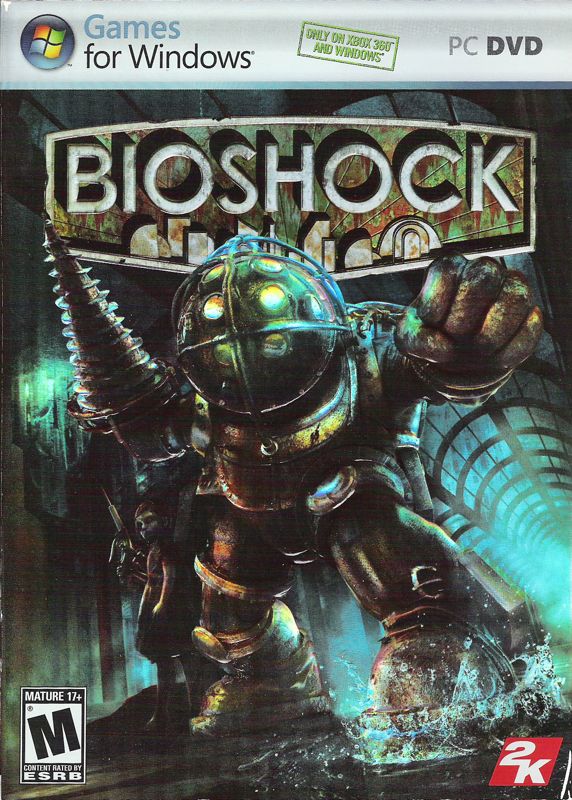
The other spine of the thing is the Little Sisters, those hollowed out girls who pull genetic material out of corpses, shadowed everywhere by the Big Daddies in the deep sea diving suits. Every time you drop one of those lumbering giants (and those fights are the real tension of the game, slow and heavy and genuinely earned) you stand over a child and decide. Harvest her for the bigger, faster power spike, or save her and take the smaller reward. It is a blunt morality system and the endings it feeds are a touch too tidy, I will grant that freely. What saves it is that this is the one choice the game hands you, sitting right beside the reveal that everything else you did was on rails the whole time. Rapture strips your agency everywhere except the single place it costs you something. That contrast is on purpose and it cuts.
The one place it settles for less
Here is the honest wound. After a twist that good, the last stretch falls apart in your hands. Fontaine jabs himself full of plasmid and swells into a glowing monster, and you fight a giant naked boss man in the dumbest way the medium has on offer, a straight bullet sponge that wandered in from a far lesser game. It is the exact moment BioShock forgets it was a philosophical machine and remembers it was sold as a shooter, and you can feel the gears grind against each other. This is the ghost of a braver ending, the one where a game this smart about obedience finds a final beat as sharp as its middle, and instead it hands you one more health bar to empty. It does not sink the game. It is a scar across the face of something that was one decision away from perfect, and it is the reason the number below is not higher.
Cut that ending off and BioShock is near flawless work: a philosophical argument you play instead of read, a city that narrates its own death through the walls, and a twist that reaches for your own obedience and uses it as the blade. It flinches exactly once, right at the end, when it should have trusted its own idea all the way home. Everything before that is a game insisting that meaning and free will are things you either seize or surrender, and it makes you feel the surrender happen in your own two hands. Would you kindly go replay it.
BioShock (2007): 95/100
Themes explored: Craft vs. Meaning · Performance and Authenticity · Externalizing the Internal
Read the spoiler-free review →